
:quality(85))
Contents
TL;DR: Search has split into three layers. SEO wins the click, AEO wins the answer, and GEO wins the citation. They are not rivals, they are one system, with SEO as the foundation the AI layer is built on. This guide draws the lines, shows how to optimise for each, and ends with a real page cited inside Google’s AI Overview.
Search used to be one game. You ranked a page, the user clicked, and you counted the visit. In 2026 that single game has split into three, and most brands are still playing only the first one.
Here is the whole article in one line: SEO wins the click, AEO wins the answer, GEO wins the citation. The rest of this guide draws the lines clearly, shows how the three work together, and ends with a real page that is cited inside Google’s AI Overview right now.
SEO | AEO | GEO | |
|---|---|---|---|
Goal | Rank and earn the click | Be the answer that shows | Be the cited source |
Surface | Classic Google results | AI Overviews, answer boxes, voice | ChatGPT, Gemini, Perplexity, AI Overviews |
Who searches | A human | An engine answering a human | An LLM retrieving for a human |
Mechanism | Ranked retrieval | Answer extraction | RAG retrieval and citation |
Main signal | Links, relevance, technical health | Clear, extractable answers | Entity authority, citation-worthy depth |
Outcome | Traffic | Visibility, often zero-click | Citation, referral, brand authority |
You measure | Rankings, clicks | Answer presence, impressions | Citations, mentions, referral visits |
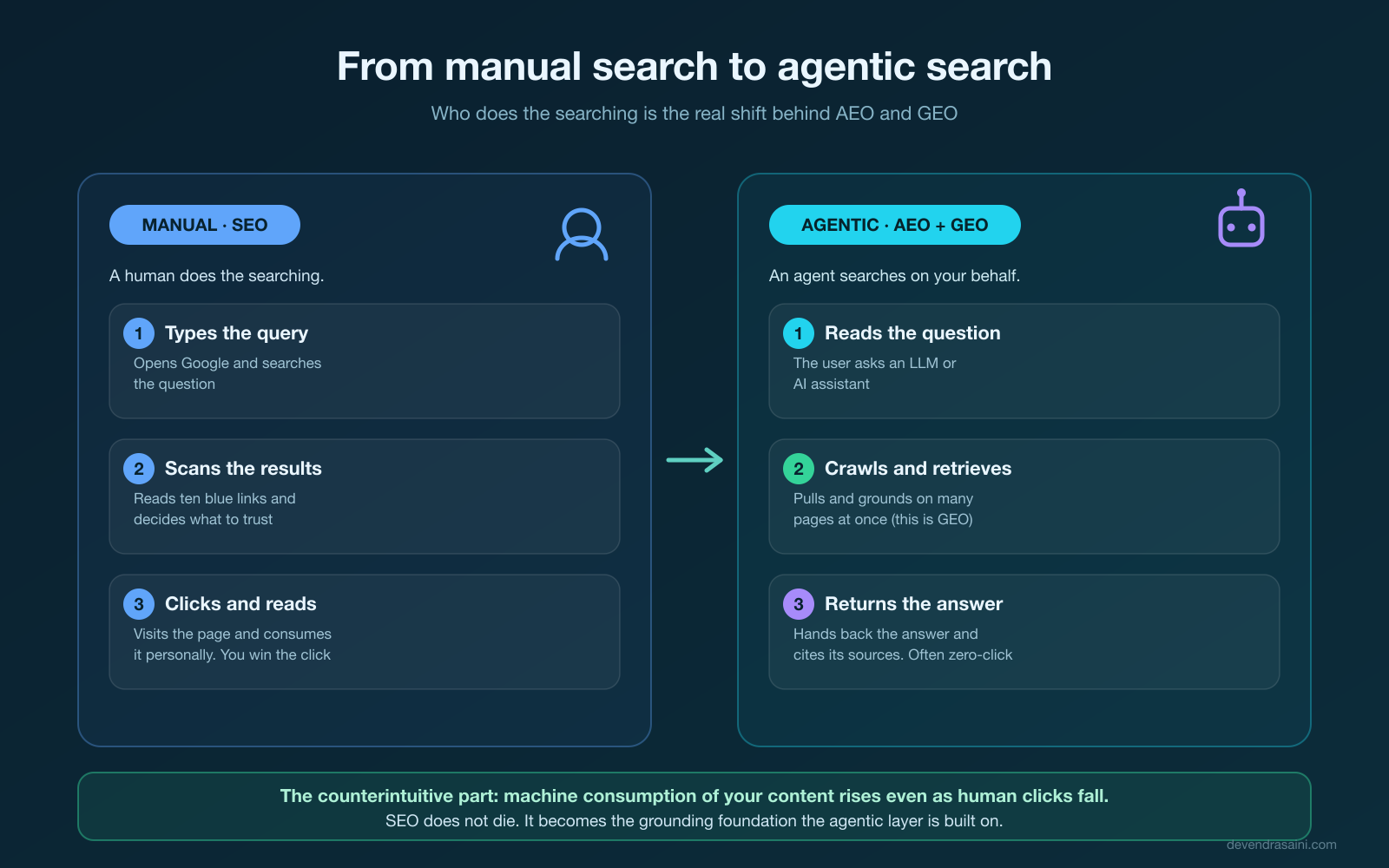
The shift nobody is naming: manual search to agentic search
Forget the acronyms for a second and look at who is doing the work.
In classic SEO, a human does everything. They type the query, scan ten blue links, decide what to trust, click, and read it themselves. The search is manual. Your job is to win that human’s attention and the click that follows.
AEO and GEO are a different layer. Here an engine or an LLM does the searching on the user’s behalf. It reads the query, crawls and retrieves pages, does the grunt work of comparing sources, and hands back a finished answer. This is the agentic layer of search, and it is where the next decade lives.
Now the counterintuitive part. People assume AI search means your content gets consumed less. The opposite is happening. Your pages are being read more, not less, because the retrieval layer is crawling and parsing them at scale to ground its answers. A single AI Overview might pull from six sources for one user, then do it again for the next thousand users. The reader of the future is increasingly an agent, and that agent reads a lot.
So SEO does not die. It becomes the grounding foundation. The cleaner, faster, and more authoritative your page is for classic SEO, the easier it is for the agentic layer to retrieve, trust, and cite. The agentic layer sits on top of that foundation and collapses the user’s time to an answer.
What each one actually means
SEO (Search Engine Optimization) is the practice of ranking your pages in traditional search results so a human finds you and clicks through. The currency is the visit. This is the foundation that everything else stands on, and it is still worth doing well. If you want the full mental model, read my guide to generative engine optimization after this.
AEO (Answer Engine Optimization) is the practice of structuring your content so the engine lifts it straight into the answer. Think AI Overviews, featured snippets, voice assistants, and chatbot replies. The trade-off is that AEO is often a zero-click win. The user gets the answer without visiting you. You trade the click for visibility and trust.
GEO (Generative Engine Optimization) is the practice of getting your page into the source set that generative engines pull from, so the model grounds its answer on your content and cites your URL. AEO is being the answer. GEO is being the source behind the answer. That distinction is the part most guides miss, so let me make it concrete.
The core differences, dimension by dimension
Goal. SEO chases a ranked position. AEO chases the answer slot. GEO chases the citation. These are three different finish lines, and a page can cross all three.
Surface. SEO lives on the classic results page. AEO lives in AI Overviews, answer boxes, and voice. GEO lives across ChatGPT, Gemini, Perplexity, and the citation panel inside Google’s AI Overviews.
Mechanism. This is the real fault line. SEO is ranked retrieval: the engine orders pages and shows you the list. GEO runs on RAG, retrieval-augmented generation. The model does not answer from memory alone. It retrieves a handful of live pages, grounds its answer on them, and cites them. The original RAG research from 2020 describes the pattern, and it is exactly how today’s AI answers get their sources.
Signal. SEO rewards links, relevance, and technical health. AEO rewards clear, extractable answers and clean structure. GEO rewards entity authority and being the most quotable source on a topic.
Outcome. SEO returns traffic. AEO returns visibility, often without a click. GEO returns a citation, a brand mention, and the referral visits that follow when a reader clicks through from an AI answer.
RAG is the GEO differentiator, so let me explain it properly
Every competitor article tells you to use structured data and moves on. That is not an explanation. Here is what actually happens when you win a GEO citation.
Crawl. The engine, or a partner search index it uses, crawls your page and stores a machine-readable version of it.
Retrieve. When a user asks a question, the model runs a retrieval step. It pulls the handful of pages most relevant to that exact query into its working context. This is the RAG retrieval step, and it happens live, at answer time.
Ground. The model writes its answer using those retrieved passages as the evidence. It is grounding the response on your words, not guessing from training.
Cite. Because the answer is grounded on specific pages, the engine attributes them. Your URL shows up as a cited source, and some readers click through.
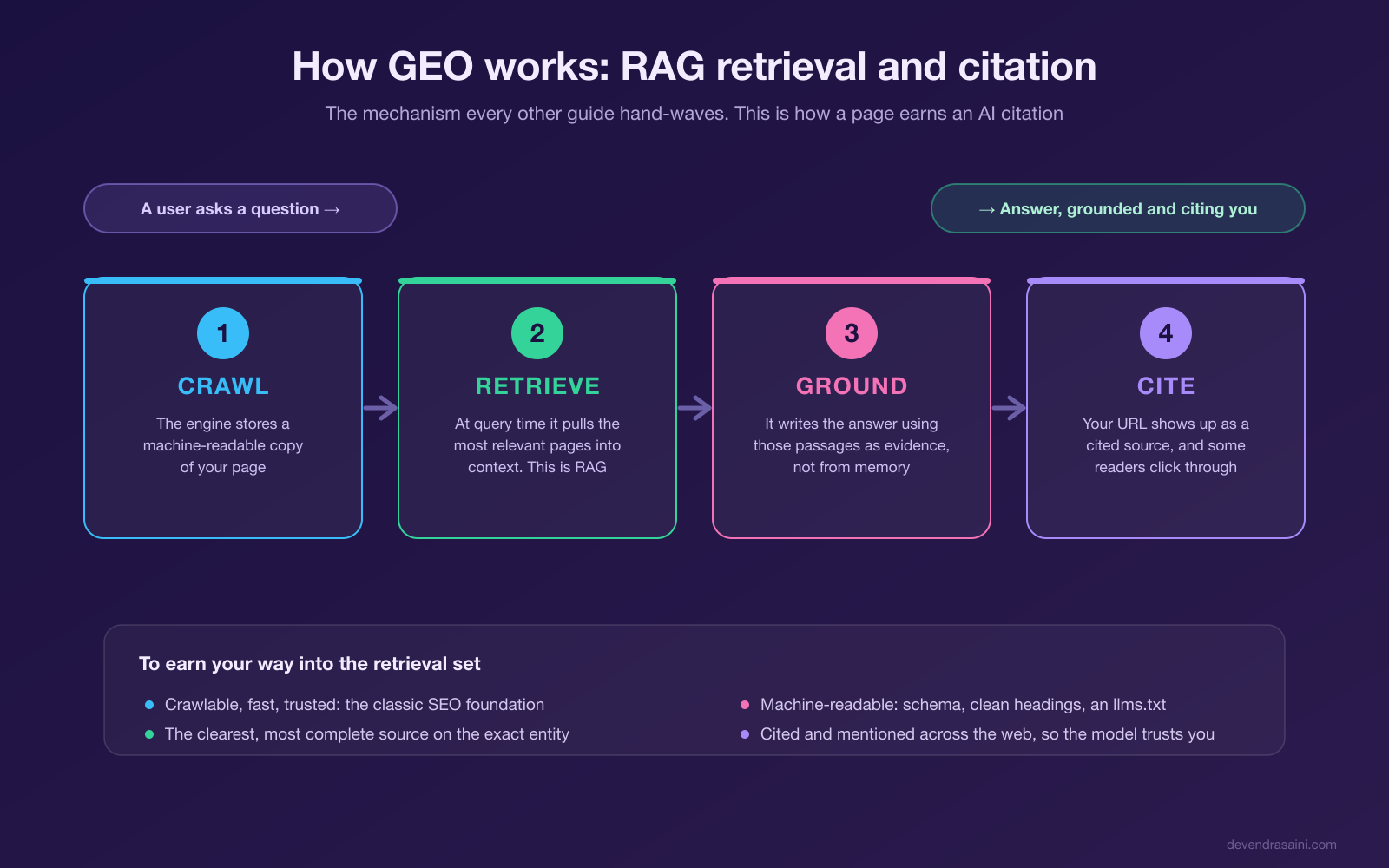
To earn your way into that retrieval set, you need three things working together. A page that classic SEO can crawl and trust (the foundation). Content that is the clearest, most complete source on the specific entity or question (so retrieval picks you). And machine-readable signals that make you easy to parse, which is where schema markup, clean headings, and an llms.txt file earn their keep. If you also want to be cited inside chatbots specifically, pair this with my guide to ranking on ChatGPT and AI.
This is the work most AI SEO advice skips, and it is the work that gets you cited.
Is SEO dead? Is AEO replacing SEO?
No, and no.
SEO is not dead, and AEO is not replacing it. SEO is the retrieval foundation that AEO and GEO both depend on. An engine cannot extract an answer from a page it cannot crawl, and a model cannot cite a source it never retrieved. What is dead is the assumption that ranking a page and waiting for the click is the entire job.
The honest shift is this. You used to optimise for one surface, the blue link. Now you optimise for three at once: the link, the answer, and the citation. The brands that win treat these as one connected system, not three competing trends.
Do you need all three?
For most businesses, yes, and the good news is that they reinforce each other. The same authoritative page can rank in classic results, get its summary lifted into an AI Overview, and be cited as a source inside a generative answer. You are not building three separate content programs. You are building one strong page and making sure it is findable, extractable, and citable.
How to optimise for each
For SEO, get the foundation right. Crawlable architecture, fast pages, clean internal linking, genuine topical depth, and real authority. Nothing downstream works without this. Google’s own guidance on AI features in Search starts from the same place.
For AEO, write for extraction. Lead sections with the direct answer, use question-shaped headings, keep key answers tight and self-contained, and add FAQ or HowTo schema so engines can lift the answer cleanly. My featured snippets guide covers the extraction patterns in detail.
For GEO, write to be cited. Be the most complete and quotable source on a clearly defined entity, earn mentions and citations across the web so the model sees you as authoritative, keep the page fresh, and make it machine-readable with schema and an llms.txt. Then track which engines actually cite you.
Can one page do all three? Usually, yes. A well-structured, authoritative, schema-rich page is exactly what each layer wants. You write it once and optimise it for three outcomes.
How to measure each
SEO is the familiar set: rankings, organic clicks, and impressions in Google Search Console. AEO is measured by answer presence, whether you appear in the AI Overview or snippet for a query, and the impressions those surfaces drive. GEO is measured by citations and mentions: how often ChatGPT, Gemini, Perplexity, and AI Overviews name you as a source, and the referral visits that arrive from AI answers. The metric for GEO is share of citation, not share of clicks.
What to prioritise first
If you are starting from zero, run them in order, because each layer sits on the one below.
SEO foundation first. Crawlable, fast, structured, and topically authoritative. Without this you cannot be retrieved or cited anywhere.
AEO next. Structure your money pages for the answer, with clean Q&A formatting and schema, so you surface in AI Overviews and answer boxes for the queries that matter.
GEO on top. Build entity authority, citation-worthy depth, and machine-readable signals so generative engines retrieve and cite you.
Do the foundation work first. The agentic layer rewards it.
A real example: a page cited inside Google’s AI Overview
This is not theory. For a global student-housing brand I work with, Amber Student, blog content is cited as the source inside Google’s AI Overviews across a large set of high-volume queries.
For the query "honours vs non honours degree which is better", Amber’s blog post is the first cited source in the AI Overview, sitting above national publishers. That is GEO working exactly as described: the page was retrieved, the answer was grounded on it, and the brand earned the citation.
:quality(82) "Amber Student is the number-one cited source in Google’s AI Overview for \"honours vs non honours degree which is better\", above national publishers. Source: Google Search.")
The breadth matters too. Amber’s blog is tracked appearing in Google AI Overviews across dozens of high-demand queries, including gen z (152,000 monthly searches), best note-taking apps (47,000), and things to do in Canada (43,000). One note on AI Overviews: citations rotate, so the goal is not a single trophy placement but durable authority across a topic. For the foundation work that makes this possible at scale, see how I rebuilt a non-branded organic engine in the MPL growth case study.
FAQ
Will AEO replace SEO? No. AEO depends on SEO. An engine cannot turn your page into an answer if it cannot crawl and trust the page first. AEO is a new layer on top of SEO, not a replacement for it.
What is the difference between SEO, AEO, and GEO? SEO ranks your page so a human clicks it. AEO structures your content so an engine shows it as the answer, often without a click. GEO gets your page into the sources a generative engine retrieves and cites. Click, answer, citation.
Can one page be optimised for SEO, AEO, and GEO at once? Yes, and it should be. A crawlable, authoritative, well-structured page with clean answers and schema can rank, get extracted into AI answers, and be cited as a source. One page, three outcomes.
How do you optimise for GEO specifically? Be the clearest and most complete source on a defined topic, earn citations and mentions across the web, keep the page fresh, and make it machine-readable with schema and an llms.txt file. That is what gets you into the RAG retrieval set.
What changed in 2026? AI Overviews and chat-based search moved from novelty to default for a large share of queries. The practical effect is that visibility now lives across three surfaces, the link, the answer, and the citation, and you have to play all three.
SEO, AEO, and GEO are three layers of one system: SEO wins the click and grounds everything, AEO wins the answer, GEO wins the citation. If you want this built properly for your brand, see my AI search consulting service, or learn more about me as an SEO expert and consultant in India.