
Contents
Google has run four spam updates in 2026 so far: in March, June, August and September. In all of 2025, it ran one. At the same time, the people who handle penalties for a living say manual action requests have jumped from almost none to several a week. Getting hit is no longer something that happens to other people's sites.
When it happens, owners usually blame links. The volunteer experts in Google's own webmaster forum usually point at the content instead, and at the content as a set. I studied 420 of those threads to see what the experts diagnosed, how often, and what owners tried that failed.
TL;DR
Penalties are rising. Google has run four spam updates in 2026, against one in 2025, and penalty specialists report a jump in manual actions.
The content set is the usual diagnosis. Scaled content led at 18%. Thin, doorway, commodity and scraped content followed at 14% each.
Manual actions often hit one section. 18 of 48 manual-action threads described an action on one part of the site, most often /blog.
"Nothing only you could say" drew the most agreement. Experts agreed on it in 33 of 45 threads.
The swap test spots doorways. Remove the place or keyword. If the pages can be swapped for each other, they are doorways, even at one page per city.
Third-party link scores do not matter to Google. Every thread about "toxic" links, spam score or DA got the same answer.
Shortcuts failed. Rewording, noindexing alone, a new folder and a new domain all failed where owners reported trying them.
Why Google penalties are a serious risk in 2026
Three signals point the same way.
1. Spam updates have sped up. Google's Search Status Dashboard lists four spam updates in 2026 so far. That is already more than in 2024 (three) or 2025 (one), and the year is not over. The September 2026 update alone took nearly two weeks to roll out, and two core updates, in March and May, landed in between. My Search Bytes timeline tracks every one of them.
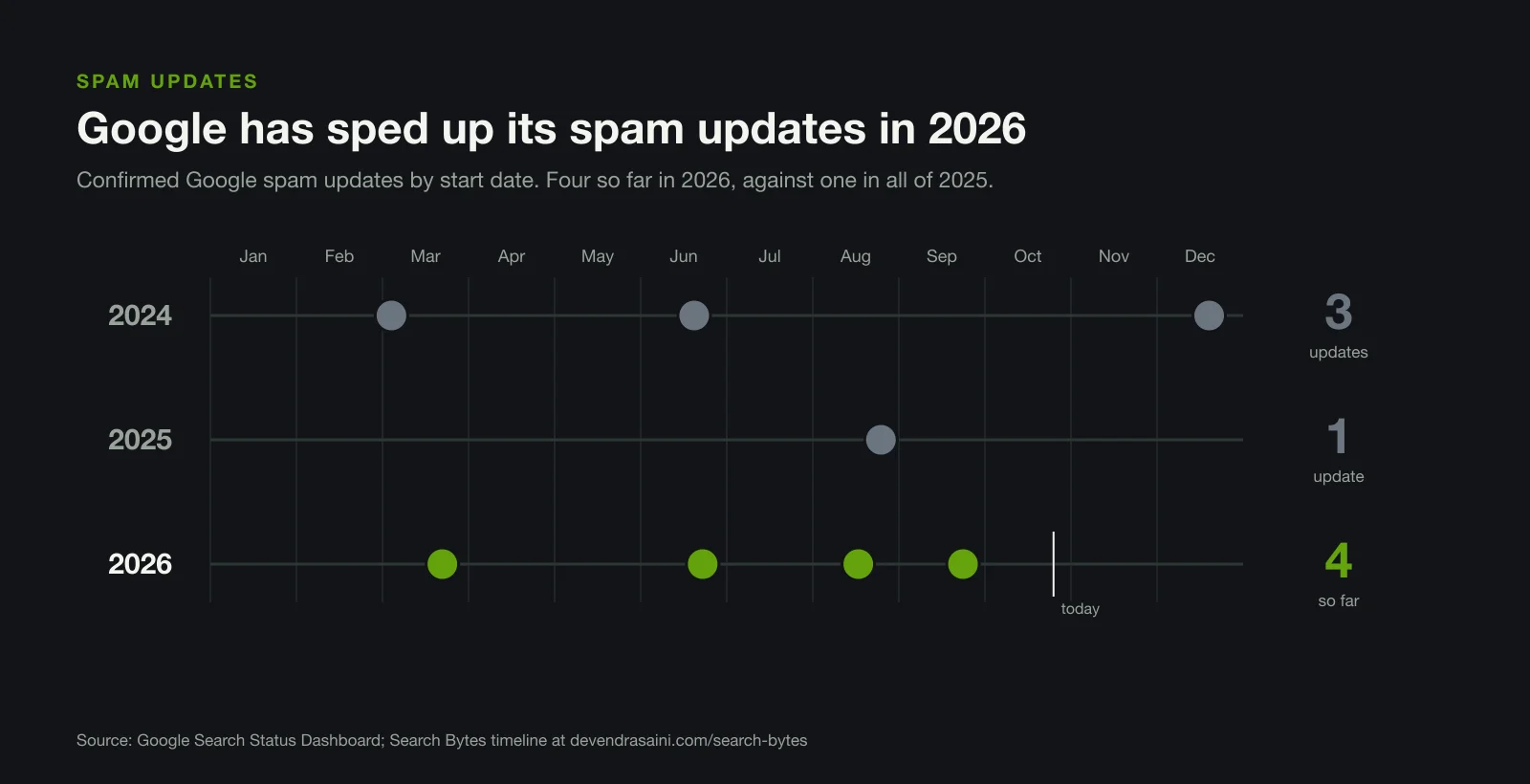
Four spam updates in ten months. Source: Google Search Status Dashboard.
2. Penalty specialists report a jump in manual actions. In October 2026, Search Engine Roundtable collected reports from people who handle penalties every week. Marie Haynes, who has worked on manual actions since the Penguin era, said requests went "from essentially no requests to several per week." Her point that matters most: these are not fly-by-night spam sites.
Have had a big increase in requests for help with manual actions lately. These include thin content, pure spam, and scaled content. Most of these sites are legitimate long standing businesses. Reminds me of 2011 - early 2012. Google went wild dishing out manual actions for…
Marie Haynes (@Marie_Haynes), October 6, 2026
Daniel Foley Carter reported the same pattern and tied it to scaled content abuse:
Google Manual Actions are appearing in so many places - the last few months I've been seeing more and more popping up. And it's no surprise, so much of the SEO industry has turned to short-cuts and scaled content abuse for the short term gains without considering the longer-term…
Daniel Foley Carter (@foley_seo), October 7, 2026
These are practitioner reports, not a Google statistic, and Google has not commented. Marie Haynes also noted that the volume is not yet near the pre-Penguin era. But the direction matches the spam-update cadence.
3. A hit is expensive. Foley Carter described manual actions that take "entire sites down with some losing 90%+ of their traffic overnight." Recovery is slow too: as I explain below, getting a section-level manual action revoked has taken four to five reconsideration requests on average in my experience.
That is why it pays to know what actually triggers a penalty before you are hit.
What is a Google penalty?
"Google penalty" is the owner's word for any sudden loss of visibility that Google caused. Google itself separates two things.
A manual action. A human reviewer decided that pages break Google's spam policies. It appears in Search Console's Manual actions report with the reason and example URLs. You ask for it to be lifted with a reconsideration request.
An algorithmic demotion. A spam update, a core update or another ranking system changed how your pages rank. There is no notice and no request to file. You change the site and wait for Google's systems to see the change.
Being "flagged by Google" usually means the first. A drop with no message in Search Console means the second, or a technical fault, or a fall in demand. Telling these apart comes first, and the section on checking for a penalty shows how.
How Google penalties have changed
Earlier, a Google penalty asked two questions: why did you do this, and how can we trust you again? You found the bad links or the thin pages, cleaned them up, explained yourself in a reconsideration request, and moved on.
Penalties from Google now ask a much harder question: should we ever trust you again? Google is not checking whether you deleted a few bad pages. It is judging whether your whole site, and the way you produce content, deserves a place in search at all. That is why patchy fixes fail, and why the data below keeps pointing at the content set as a whole rather than at single pages or links.
How the study worked
The threads come from the public Google Search Central Help Community, where site owners ask for help and volunteer Product Experts answer.
Collection. Public pages only, no login. A named crawler respected robots.txt and waited several seconds between requests.
Selection. 11,404 threads were listed. Keyword rules found 1,449 with at least one reply, and 420 were picked evenly across topics. Rare topics are in on purpose, so the shares below are not the forum's natural mix.
Reading. An AI-assisted first pass turned each thread into one record: the problem, the kind of site, and each expert's diagnosis, level and signals. I grouped the 639 signal labels into 43 families and checked the counts against the records.
Who answered. 382 threads had a diagnosis from a Diamond, Platinum or Gold Product Expert. These are volunteers recognised by Google, not Google staff, and no Google employee replied in this sample. As one Diamond Product Expert told a poster, "we are not employees and have no impact on the reconsideration process."
Limits. People post when they are stuck, so this is a sample of hard cases. Experts see the public site, not your Search Console data. Most counts are small, so read them as direction, not as rates. 60% of the threads are from 2026, and all are in English.
What the experts diagnosed most often
In 319 threads, a top-level expert named at least one specific cause. Five led, and all five are about the content set as a whole.
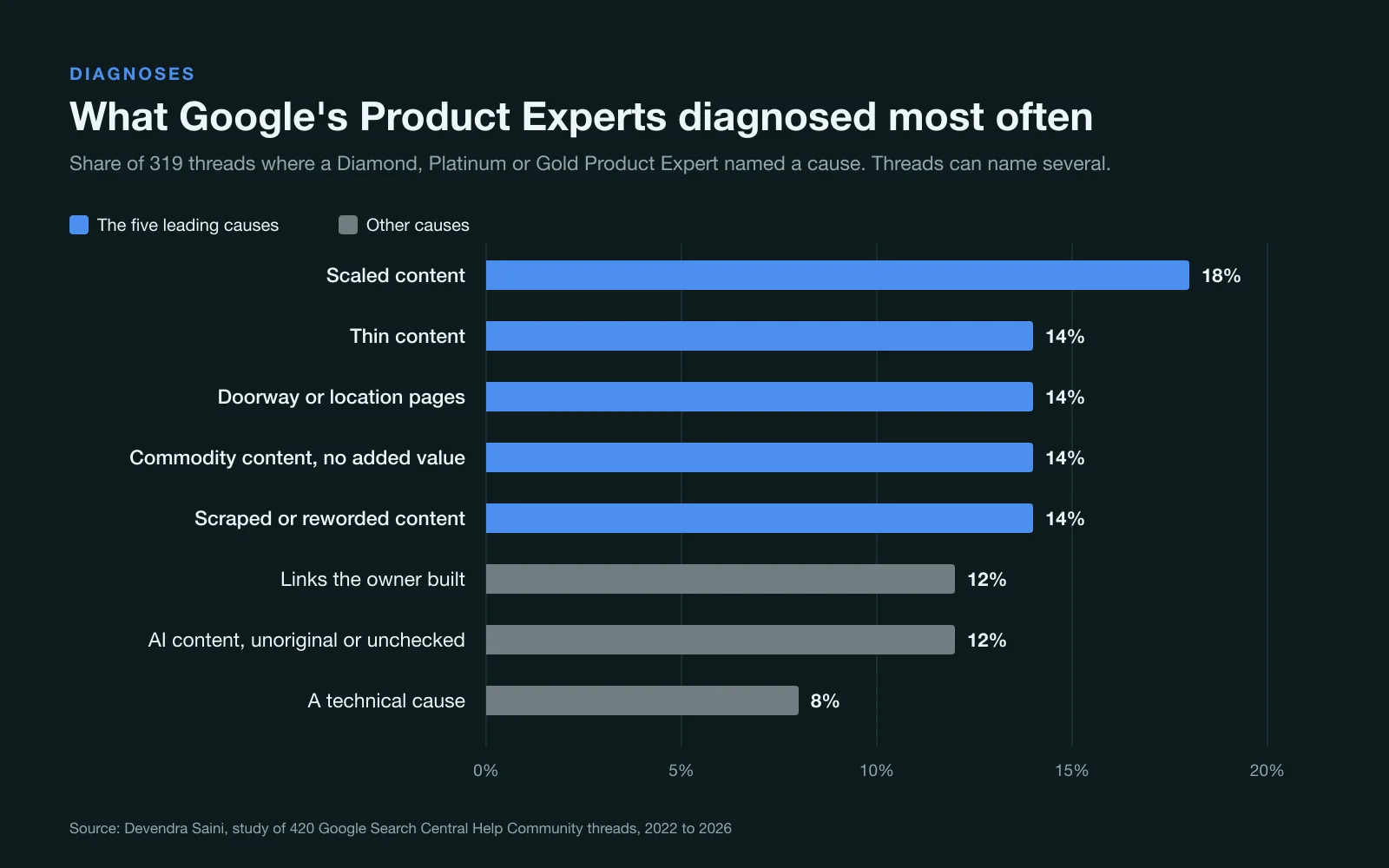
The five leading causes are all about the content set. Source: study of 420 Search Central Help threads.
Diagnosis | Threads | Share |
|---|---|---|
Scaled content (mass-produced, fast, auto-generated) | 57 | 18% |
Thin content | 46 | 14% |
Doorway, location or keyword-variant pages | 46 | 14% |
Commodity content, no added value | 45 | 14% |
Scraped, copied or reworded content | 44 | 14% |
Links the owner built | 37 | 12% |
AI content, unoriginal or unchecked | 37 | 12% |
A technical cause (noindex, robots.txt, rendering, firewall, migration) | 26 | 8% |
A thread counts once per cause, and many threads named several.
The mix shifts by problem type. Scale and commodity content led in manual actions and spam updates, while technical causes led in indexing problems.
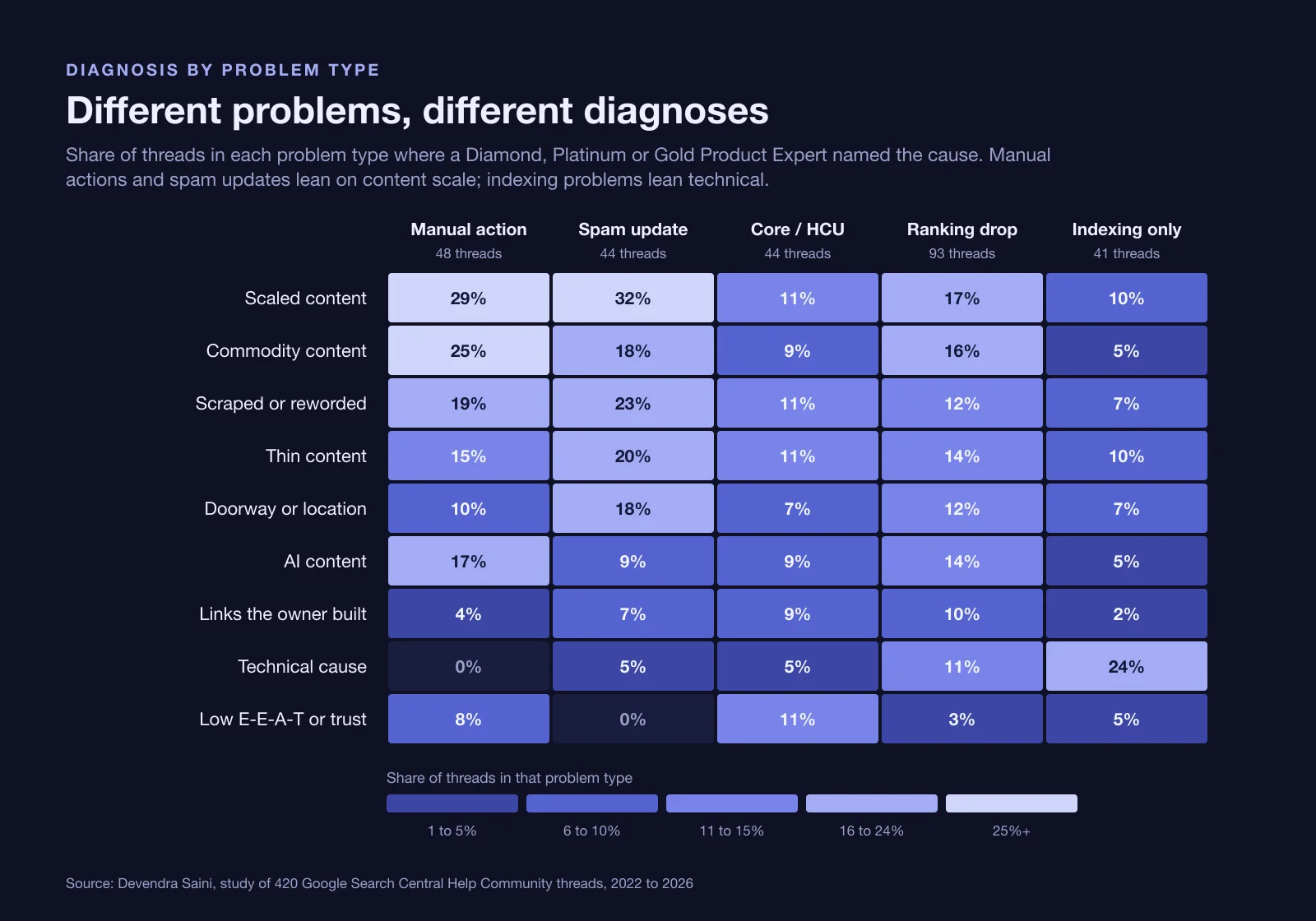
Different problems, different diagnoses. Each cell is the share of threads in that problem type.
Scaled content: the set is the problem
Scaled content was the most named cause overall. It also led in manual actions (29%) and spam updates (32%). Google added it as a spam policy in March 2024. It defines it as "when many pages are generated for the primary purpose of manipulating Search rankings and not helping users."
The experts judged the pattern, not single pages. Think of many pages that differ only in a slot (a city, a product, a keyword), published fast from AI or a data feed. Typical signs were huge page counts on young domains, and a fast traffic climb followed by a site-wide cliff.
Thin and commodity content: nothing only you could say
Commodity content had the strongest agreement in the study. The test is simple: does the page add anything the search results do not already show? Generic explainers, converter tools an AI answer can replace, listicles, coupon pages and aggregators all failed it. As one Diamond Product Expert put it, "Anything that scales easily is at risk."
Thin content was treated as a site-wide trend rather than a page fault. Image-only pages, empty listing pages and pages with one sentence and some buttons were dropped as a class.
Scraped and reworded content
Rewriting, synonym swaps, "humaniser" tools and AI rewrites of a feed were all treated as scraping. Citing the original source did not save an aggregator in 4 threads. Plain duplication on your own site is a different matter, covered in the myths below.
AI content: the problem is unoriginal, unchecked output
Experts almost never named AI on its own. It came alongside scaled or commodity content. That matches Google's published guidance: "Appropriate use of AI or automation is not against our guidelines." What experts flagged was the output. One page was published unedited with its own optimisation brief still attached. Others had image-generator file names, or a handful of authors credited with thousands of posts.
Lily Ray reached the same view from traffic data: "scaling content production with AI is not a low-risk strategy for organic search" (May 2026). I have also tested how well models audit content in my AI content audit benchmark.
I'd say avoid AI content at scale. It is very tough to moderate the quality of mass AI output, and tough to proofread everything, because AI can scale things so easily. You can even scale it unintentionally: translations in multilingual SEO can leave a large AI footprint. When you publish at that scale, it raises red flags in the algorithm. Google might see something fishy, and if you scale too drastically, your website might get evaluated manually. Most low-value AI content is slop, and slop doesn't work.
But if you use AI as part of your content engineering, that is quite good. Engineer the content with AI, get it reviewed by an expert, run tons and tons of quality checks, then publish. That helps you churn out good content and fight much better. That's what I am doing at Amber.
Manual actions usually hit one section, not the whole site
Of the 48 manual-action threads, 18 described an action on one section, most often /blog, rather than on the whole domain. The same story repeated on SaaS, training, real-estate and finance sites: a solid product site with a blog whose editorial calendar followed keyword volume. The product pages were fine. The blog was the commodity layer.
That matters because a site-wide average hides it. A strong homepage and good product pages do not protect a section that is mass-produced.
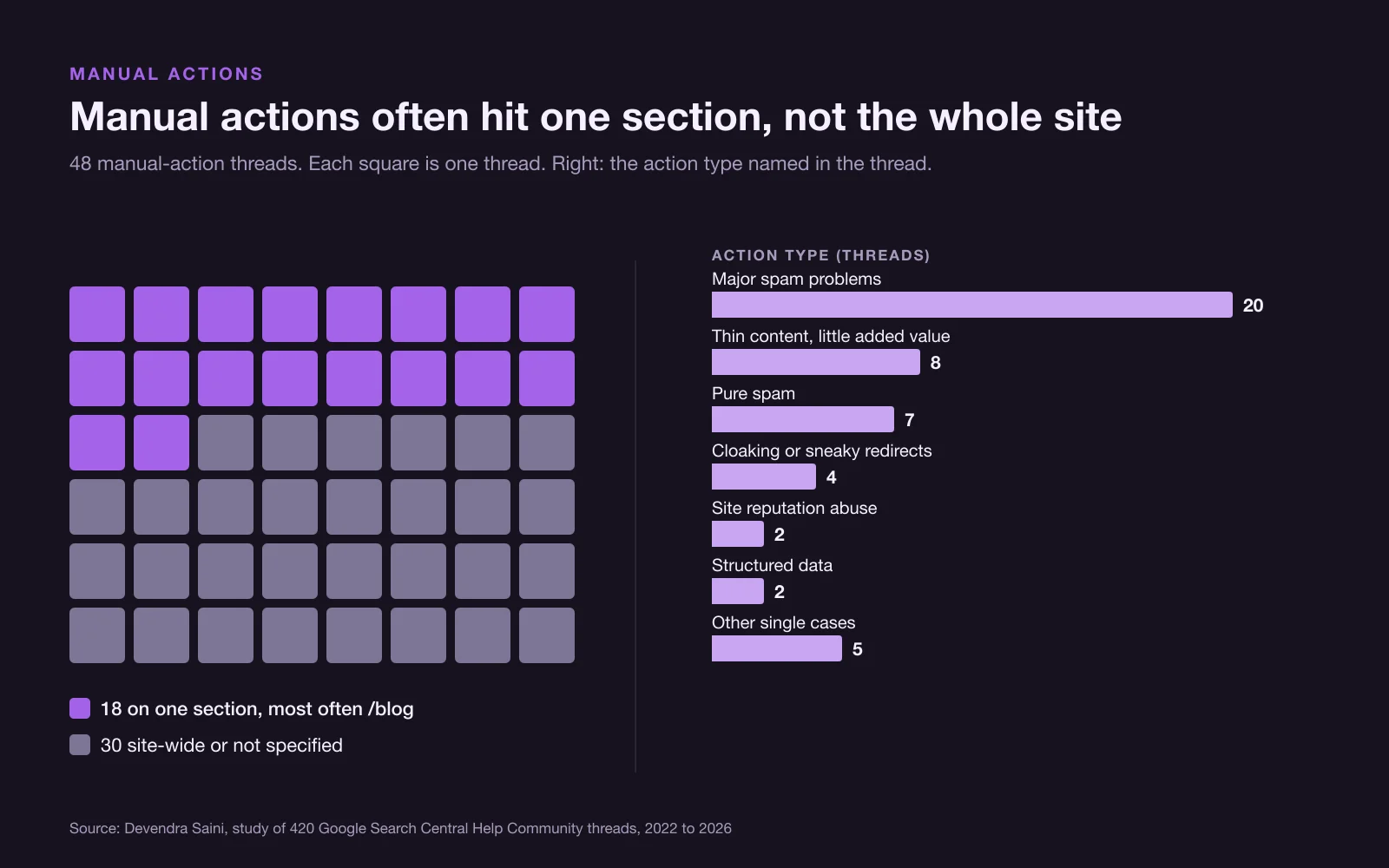
18 of 48 manual actions landed on one section of the site.
Manual action (as named in the thread) | Threads |
|---|---|
Major spam problems | 20 |
Thin content with little or no added value | 8 |
Pure spam | 7 |
Cloaking or sneaky redirects | 4 |
Site reputation abuse | 2 |
Structured data | 2 |
Scaled content abuse, user-generated spam, third-party spam, Discover policy, an action inherited with a bought domain | 1 each |
One multiplier stood out. Machine-translated copies came up in 12 threads, including 3 manual actions. Blogs auto-translated into 11 to 28 languages turned a weak set of posts into a scaled one.
I have seen multiple manual actions where only the blog, or one section of the website, got hit. Google does tell you what kind of manual action it is: major spam problems, scaled content abuse, pure spam or another type. That folder then gets deindexed completely, and you have to submit a reconsideration request to get the penalty revoked.
And it is tough to recover a folder like the blog. You have to do lots and lots of things to actually recover now. Patchy fixes, partial work and reconsideration requests submitted too early mostly get rejected nowadays. It can take multiple attempts: on average around four to five reconsideration requests, in my experience with other businesses. A couple of them have recovered. A couple are still not done. Precaution is better than cure.
The swap test: how experts spot doorway pages
Google defines doorway abuse as "when sites or pages are created to rank for specific, similar search queries." The experts used a practical test. Take the place or keyword out of the page, then compare the pages. If they can be swapped for each other, they are doorways.
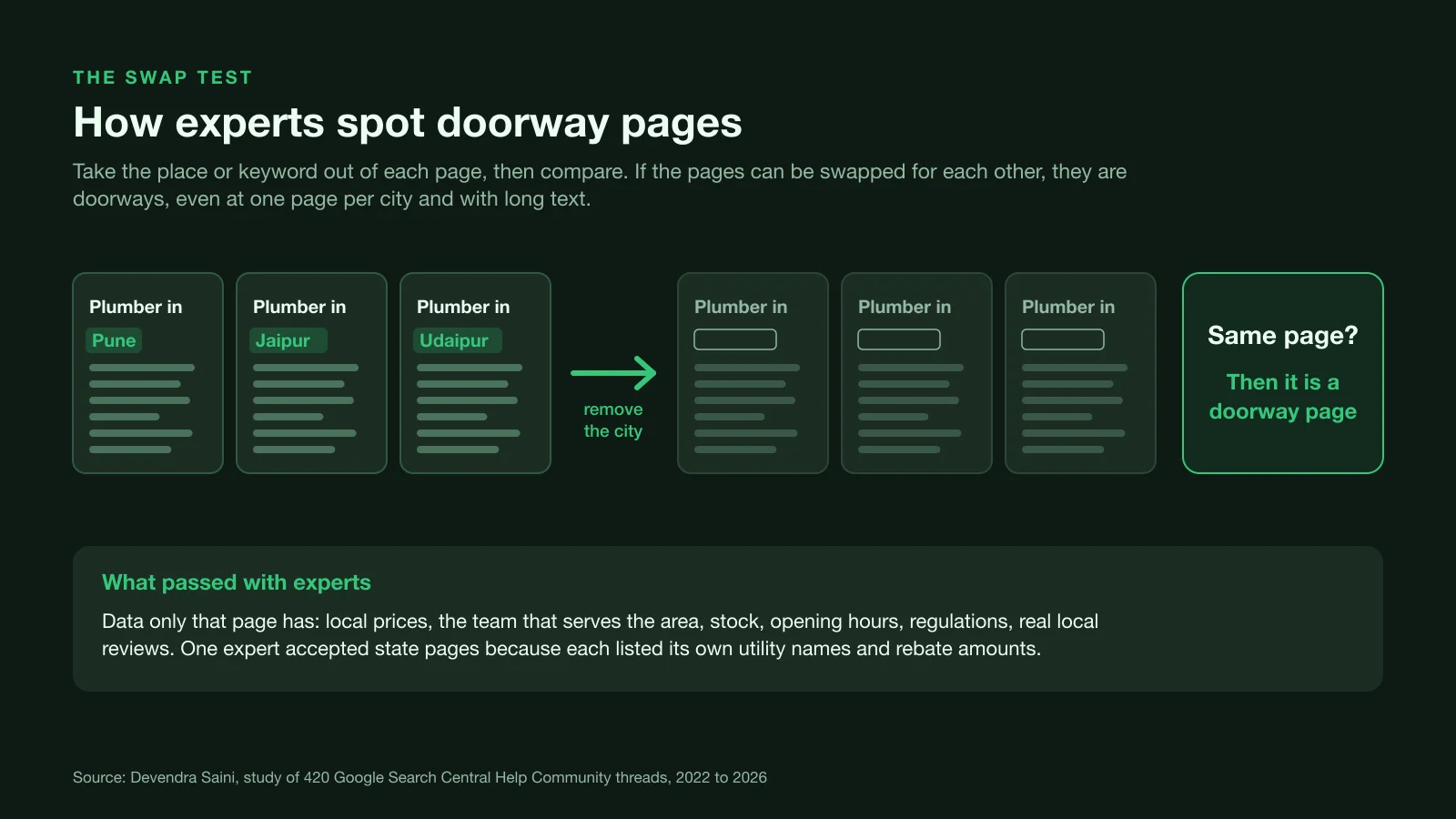
If the pages still read the same without the place name, they are doorways.
Experts called pages doorways:
at one page per city, where the business had no presence in that city
with about 1,800 words of templated text per page (2 manual actions)
for synonym and route variants ("baby", "infant", "toddler"), not only for places
when a large brand built them slowly
A second test came up too: would a visitor on your homepage ever filter by this location? If not, the page exists for search engines.
Proportion decides how far the damage goes. As a Gold Product Expert said of one site, it "depends on how much of the site is "doorway" pages." What passed was data only that page had. One expert accepted state pages because each listed its own utility names and rebate amounts.
In my experience, doorway penalties are usually part of spam updates, and websites usually get deindexed during these updates. Doorway pages are low-value, thin, programmatic pages, often made with a lot of AI, that are quite similar to each other. They are made just to scale the website programmatically, target a large set of keywords and rank. There is no core business offering behind them; you are just templatising the content to rank. That is the typical doorway case, and these pages usually get a manual action plus a spam penalty, both.
The best way out is to get rid of these pages as soon as possible. If the programmatic segment is part of your core offering, provide real value in it. If it isn't, just don't create these pages. As simple as that.
Owners blame links. Experts point to the content.
Links were the owners' favourite theory and rarely the experts' answer. In 63 threads, the owner blamed links and a top expert named a cause. In 51% of them, the experts said links were not the cause. In 35%, they found links the owner had built. In 21%, they pointed to the content instead.
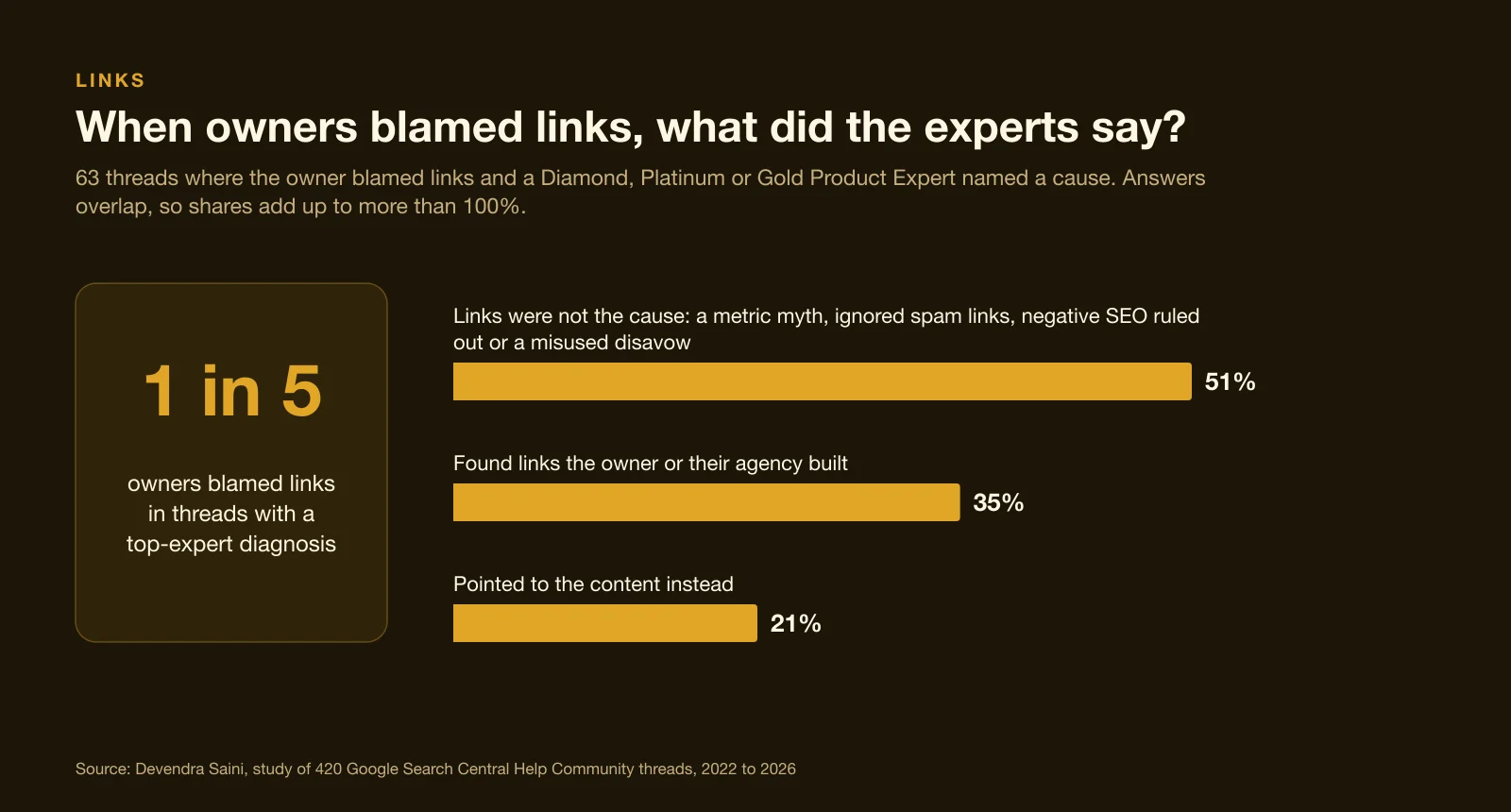
When owners blamed links, half the time the experts said links were not the cause.
Third-party scores. 17 threads asked about spam score, "toxic" labels, DA or DR. The answer was the same every time: Google does not use them, and a disavow file does not change them. One Diamond Product Expert called the toxic label "SEO malpractice."
Negative SEO. In 15 threads the owner blamed a competitor's spam links. In 11 of them, more than one expert agreed that was not the cause. Random spam links are ignored.
Links the owner built. When experts dug in, they often found links the owner or an agency had placed. Examples were keyword-rich footer credits, posts on free blog platforms and "write for us" pages.
Google's disavow guidance says "most sites will not need to use this tool." It also warns that using it wrongly "can potentially harm your site's performance."
Links do have a penalty in place. But Google usually declares link penalties as link spam in a manual action, where you also get a sample of the manipulative link building tactics you used. So link penalties are a separate thing. If the links were built intentionally, you have to get them removed. The ones you can't remove, disavow.
Taking part in link schemes is one of the easiest ways to get a penalty. Link exchanges, A-B-C schemes: no matter how sophisticated you make them look, Google is now able to catch manipulative link schemes. Google can also devalue manipulative links so they don't pass any link juice.
Google penalty myths the experts kept correcting
What the owner believed | What the experts said | Threads |
|---|---|---|
Google detected the AI | The problem is unoriginal or unchecked output, not the tool | Recurring |
Rewording makes pages unique | Masses of similar pages are the signal, whatever the wording | 6 or more |
Long pages are safe | Templated pages of about 1,800 words were still doorways | 2 manual actions |
E-E-A-T is a checklist (author box, editorial policy, disclaimers) | Reviewers judge the content. Policy pages are cosmetic | 6 |
There is a duplicate content penalty | Plain duplicates get grouped and one version is shown. Only scraping or manipulation is acted on | 2 or more |
Crawl budget or URL depth caused it | Irrelevant at these sizes. "Crawled, currently not indexed" is a quality decision | 5 or more |
A fall in impressions means a penalty | Often a change in demand, or the September 2025 reporting change, while positions held | 4 |
A new domain escapes the verdict | The same verdict followed, or it got worse | 4 |
Quality raters penalise sites | Raters assess sets of results in aggregate. They do not act on single sites | 3 |
llms.txt, Markdown copies or "GEO" files help in Google | Google Search does not use them | 3 |
The duplicate content row matches Google's 2008 post on the "duplicate content penalty". Google acts only on deceptive duplication, such as scraping.
On llms.txt, Google's AI optimisation guide is precise: Google Search does not use such files. The same guide says it is "completely fine" to keep one for other services that use it.
I just keep llms.txt for hygiene. It doesn't cost me anything extra; it is a low-effort item. You can keep the file too, but you shouldn't overemphasise it or put more effort into it. Just have a hygiene file in place and keep it well structured. Who knows, some other crawler might start using it in future.
What gets a Google penalty lifted, and what failed
For a manual action, Google's process is clear. Fix the issue on every affected page, select Request Review in the Manual actions report, and describe your fixes. Google says most reviews take several days or weeks, link-related ones can take longer, and you should not resubmit before you get a decision. For an algorithmic drop there is no request to file. Google's core update guidance says it "could take several months for our systems to learn and confirm" your improvements. My core update recovery playbook covers that path.
The bar is the whole pattern. Google's Manual actions report puts it plainly: "Fixing the issue on just some pages will not earn you a partial return to search results."
The experts said the same:
Remove the pattern, not a sample of pages. Reviewers check the page types that used to rank.
Explain how you changed the way content is made, not only what you deleted: who writes, what earns a page its place, and how many pages went.
Where the business model itself breaks the rules, such as an unofficial portal for another organisation's service, no clean-up helps. Rebuild as a different site.
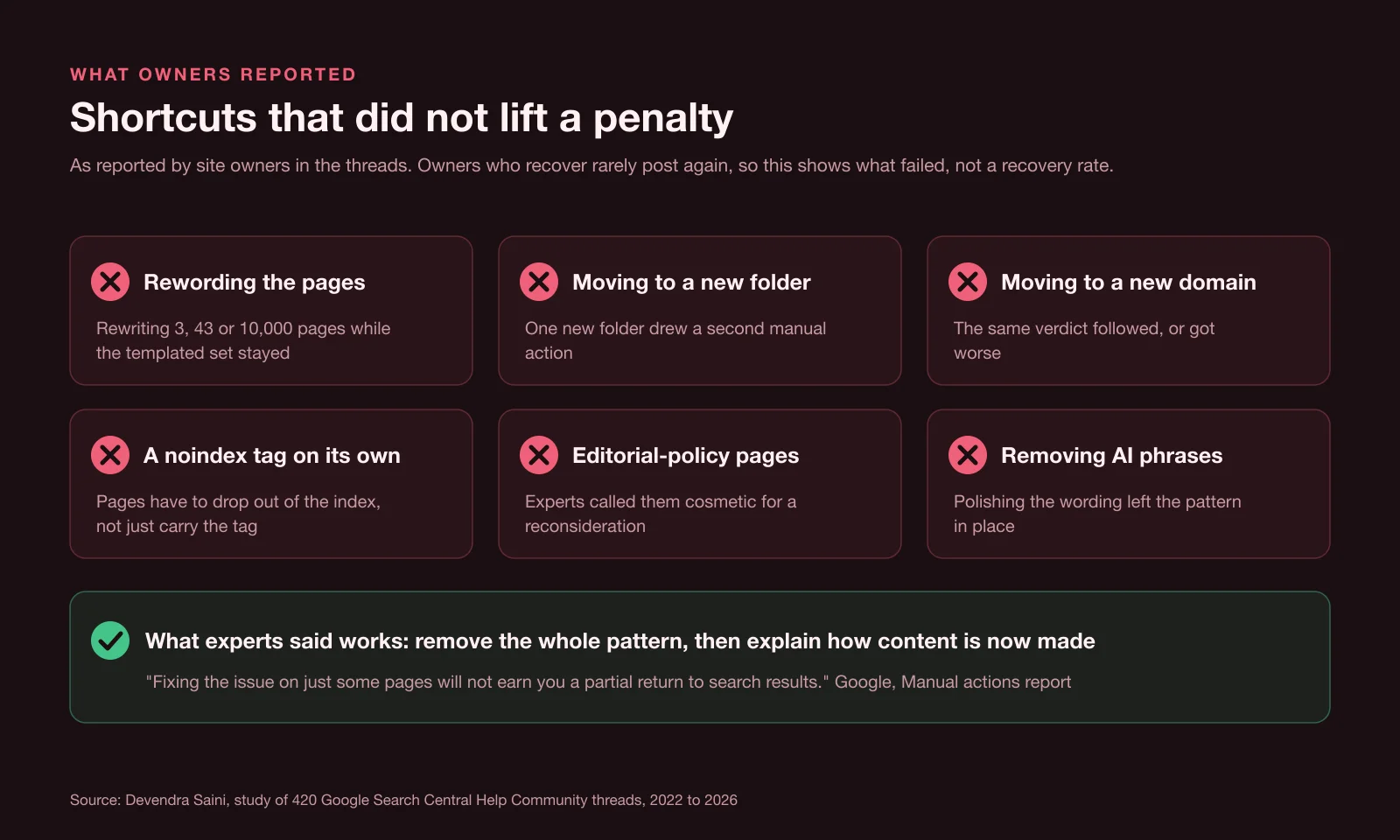
What owners reported trying. The forum shows the stuck cases, not a recovery rate.
What owners reported trying without success
What they tried | Threads |
|---|---|
Rewriting pages while the templated set stayed | 4 or more |
Moving to a new domain, or the content to a new folder (one new folder drew a second action) | 4 |
Noindexing most pages, or only the template pages | 2 |
Cutting posts while the machine-translated copies stayed | 1 |
Removing AI phrases, polls and listicles | 1 |
Adding editorial-policy pages | 1 |
Reducing ads while the content stayed the same | 1 |
Read this table as what failed for the people who posted. Owners who recover rarely come back to the thread, so the forum shows the stuck cases, not how often recovery happens. Glenn Gabe, who tracks spam-update recoveries, puts it simply: "Google will need to see a clean site over an extended period of time."
From my side: rewording doesn't work. Moving to a new folder, if the content and things are still the same, gets penalised again. And moving to a new domain without addressing the core issues is just a waste of work. Whether it is a manual action or an algorithmic penalty, both carry forward. Noindexing might work, or might not. It is not just a matter of placing the noindex tag: the page also has to be out of the index.
I have recovered sites myself. One was hit by a core update; we deleted the programmatic spam section entirely, and the website recovered with the next core update. The other was mainly a manual action, and the issues were quite severe. It took around eight months and multiple requests to recover.
How to check if your site has a Google penalty
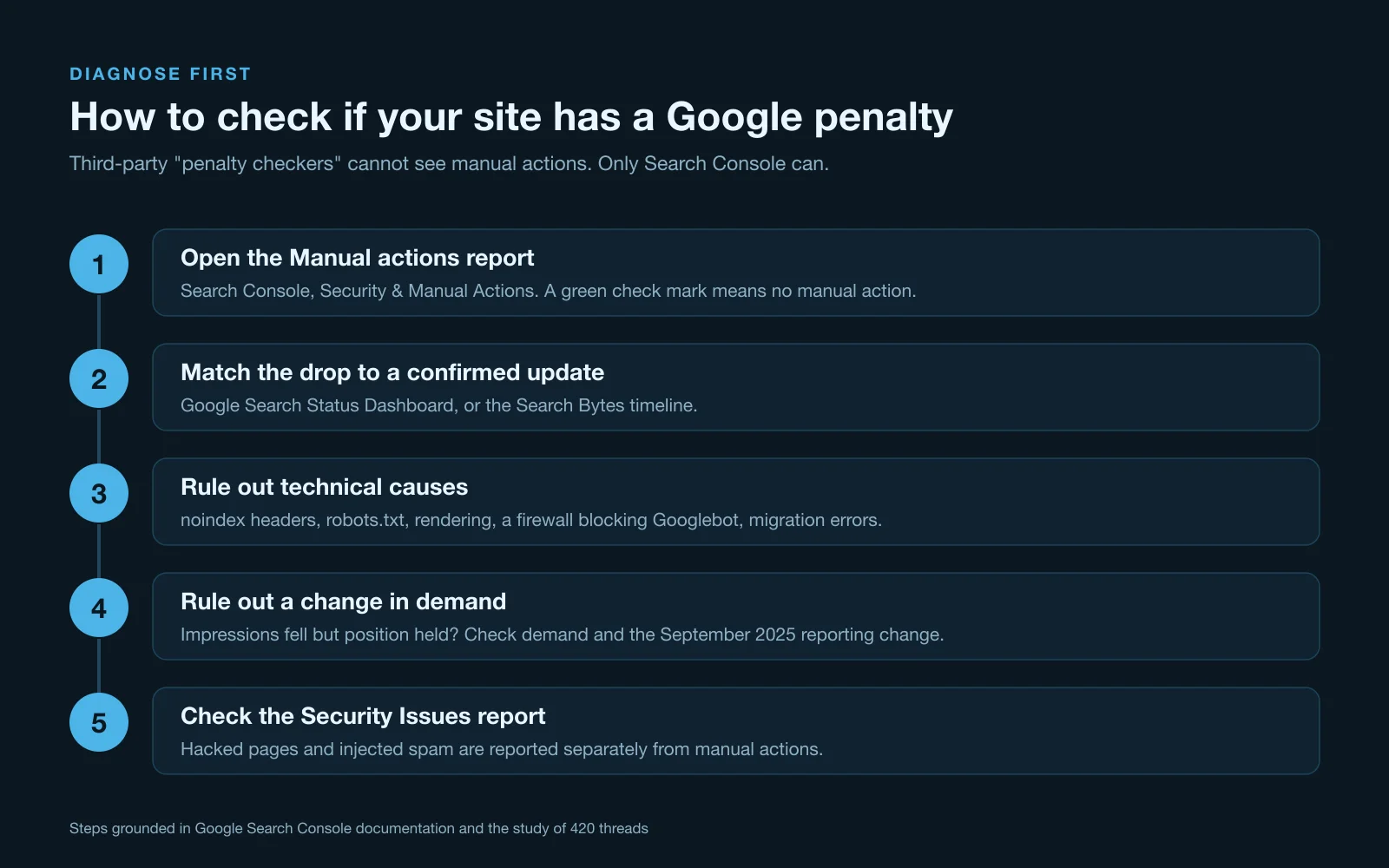
Diagnose before you fix anything.
Open the Manual actions report in Search Console, under Security & Manual Actions. A green check mark means no manual action. If there is one, it names the issue and gives example URLs. Third-party "penalty checkers" cannot see this report. They only compare your traffic with update dates.
Match the drop date to a confirmed update. Use Google's Search Status Dashboard, or my Search Bytes timeline of confirmed Google updates. Experts matched dates to rollouts in 13 threads.
Rule out technical causes first. Check for noindex headers, robots.txt blocks, rendering failures, a firewall blocking Googlebot and migration errors. A technical cause led in indexing threads (24%), and most of the fixes owners reported back were technical.
Rule out a change in demand. If impressions fell but position held, check demand and the September 2025 reporting change first.
Check the Security Issues report. Hacked pages and injected spam came up in 15 threads, and they are reported separately from manual actions.
How to avoid a Google penalty: five checks from the data
Run the swap test on every templated set: location pages, product variants, programmatic pages.
Score each section separately. The blog is where manual actions most often landed.
Ask of each page: what could only we say here? If the answer is nothing, it is commodity content.
Watch your publishing and rewrite speed. Sitemaps showing 200+ rewrites a day were read as scaled content in 4 threads.
Audit the rare signals that decided cases. Look for machine-translated copies, menu links that open ads, fake authors, and fake reviews in structured data. Check the history of any domain you buy.
FAQ
Is there a duplicate content penalty? Not in the way most people mean it. Google groups plain duplicates and shows one version. It acts only on deceptive duplication, such as scraping.
How long does a Google penalty last? For a manual action, Google says most reconsideration reviews take several days or weeks once you request one, and link-related reviews can take longer. For an algorithmic drop, Google says it can take several months for its systems to see your improvements.
Do Google employees answer questions in the Search Central Help Community? Mostly no. The answers come from Product Experts, who are volunteers recognised by Google. No Google employee replied in the 420 threads studied.
Can a penalty follow a domain to a new owner? Yes. In this sample, a manual action survived a domain's expiry and re-registration. If you bought such a site, Google asks you to fix the issues and mention the purchase in your reconsideration request.
Does Google penalise AI content? Not for being AI. Google says appropriate use of AI is not against its guidelines. Scaled, unoriginal or unchecked output is the problem, whoever or whatever wrote it.
Will disavowing links lift a penalty? Only when links caused a manual action and you cannot get them removed. Google warns that "blindly adding all backlinks to the disavow file is not considered a good-faith effort."
The short version
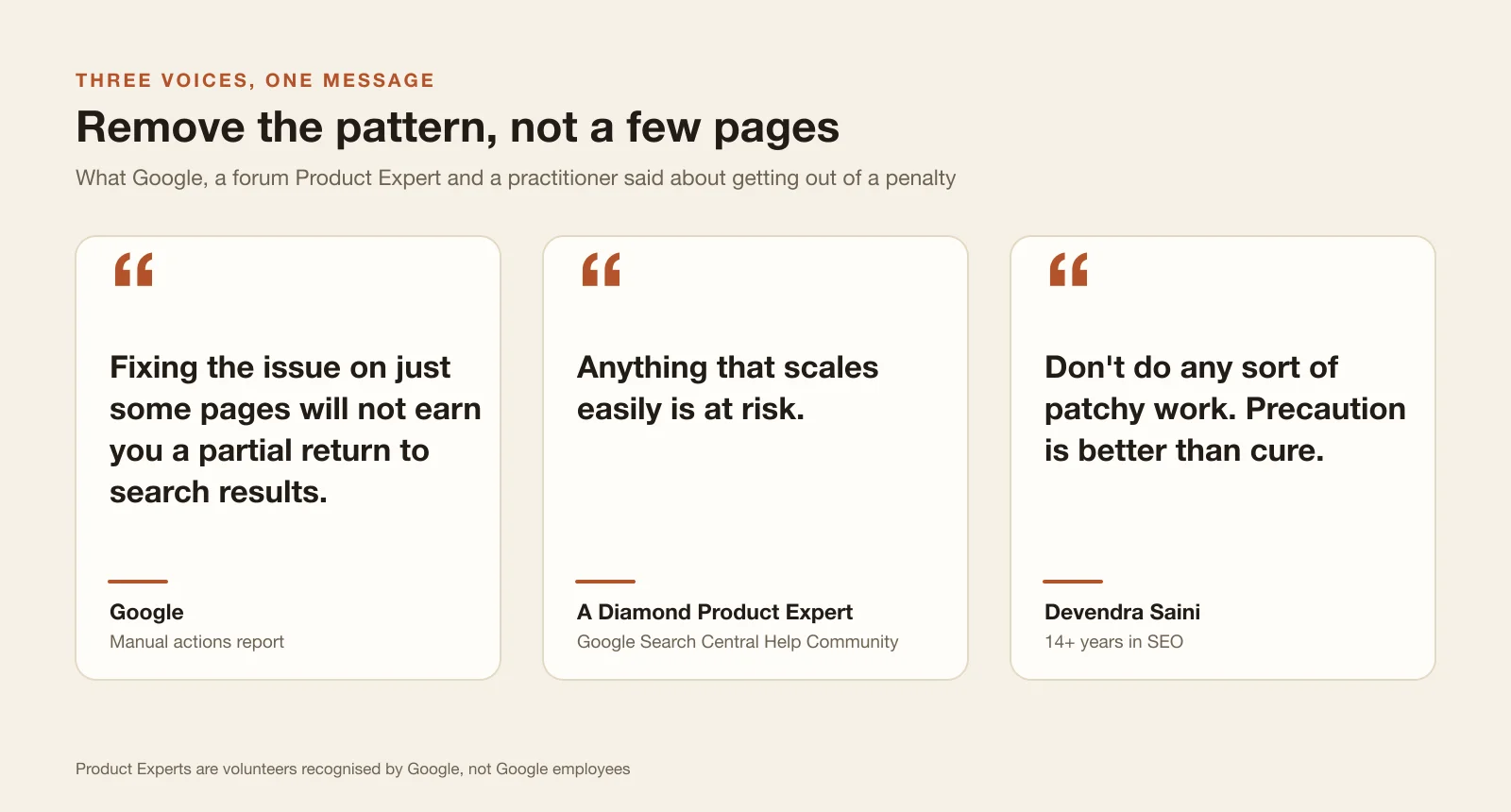
Three voices, one message: remove the pattern, not a few pages.
Google penalties in this study were rarely about one bad page or one bad link. They were about a pattern, usually a mass-produced section, and the way out was to remove the pattern, not polish the pages inside it.
My best advice if you have been hit: rethink very carefully. Don't do any sort of patchy work. Don't think you'll just do X number of things and your website will recover. When you get hit, your fundamentals have been challenged by Google, and you don't comply with the guidelines. So rethink your strategy from the core. Make substantial changes, and in severe cases you might have to remove everything and redo it. Take your time, understand things carefully, then start executing. Google is stricter now than it has ever been, with manual actions going out to lots and lots of websites. Precaution is better than cure.
I am Devendra Saini, an SEO expert and consultant in India with 14+ years of practice. If your site has been hit and you want a second pair of eyes on the cause, talk to me about a recovery audit.
Google Product Experts are volunteers recognised by Google. This study is independent and is not affiliated with or endorsed by Google.