
Imagine you have a giant library, but instead of walking through the aisles and picking out books, you just stand at the front desk and talk to a super-smart robot librarian. You ask, “What’s the best way to bake a cake?” and instead of handing you five cookbooks, the robot just tells you the answer. This isn’t science fiction; this is the world of 2026, and it’s called AI Search.
For a long time, we tried to please Google by using “Blue Links.” But today, search is undergoing a fundamental change. AI engines like ChatGPT, Perplexity, and Gemini aren’t just showing websites; they are owning the relationship with the user. If you want your website to be the one the robot librarian picks, you need to change how you play the game.
The End of the “Old Ways”: Why Backlinks Aren’t Enough
Back in the day, if you wanted to be #1 on Google, you needed lots of other websites to link to you. These were called “backlinks.” But when we look at how AI chooses which websites to mention (we call these “citations”), the old rules are breaking.
The 4% Rule
Experts at Profound analyzed over 250 million AI responses and 3 billion citations. They found something shocking: traditional SEO metrics, like how many people link to you, explain only about 4% to 7% of whether an AI will cite you.
Think of it like a talent show. Having a lot of friends in the audience (backlinks) used to help you win. Now, the judges only care about how good you actually perform on stage. The real winners in 2026 are driven by content quality, expertise, and freshness.
Diminishing Returns on Authority
You might think that having a “High Authority Score” makes you a lock for an AI answer. It helps, but only a little. Doubling your SEO metrics only gives you about 25% to 40% more citations. This means you can’t just “buy” your way to the top with old tricks. You have to be genuinely helpful.
Key Takeaways for the “New SEO”:
- Quality over Quantity: One amazing article is better than 100 okay ones.
- Direct Answers: AI likes content that takes a position and answers the question immediately.
- Freshness: Half of the most cited content is less than 13 weeks old.
The “Speed Date” with an AI: Winning the First 100 Characters
AI engines are a bit lazy. When they look for an answer, they don’t always read your whole website first. Instead, they do a “speed date” with your page.
The Four Pillars of the Pitch
ChatGPT and other engines usually only see four things before deciding if you are worth citing:
- Your URL: The address of your page.
- Your Title: What the page is called.
- Your Description: A short summary (metadata).
- A Snippet: A tiny piece of text from your page, usually about 100 characters long.
If these four things don’t look perfect, the AI will move on to the next website without even clicking on yours.
Why Your URL is Your Secret Weapon
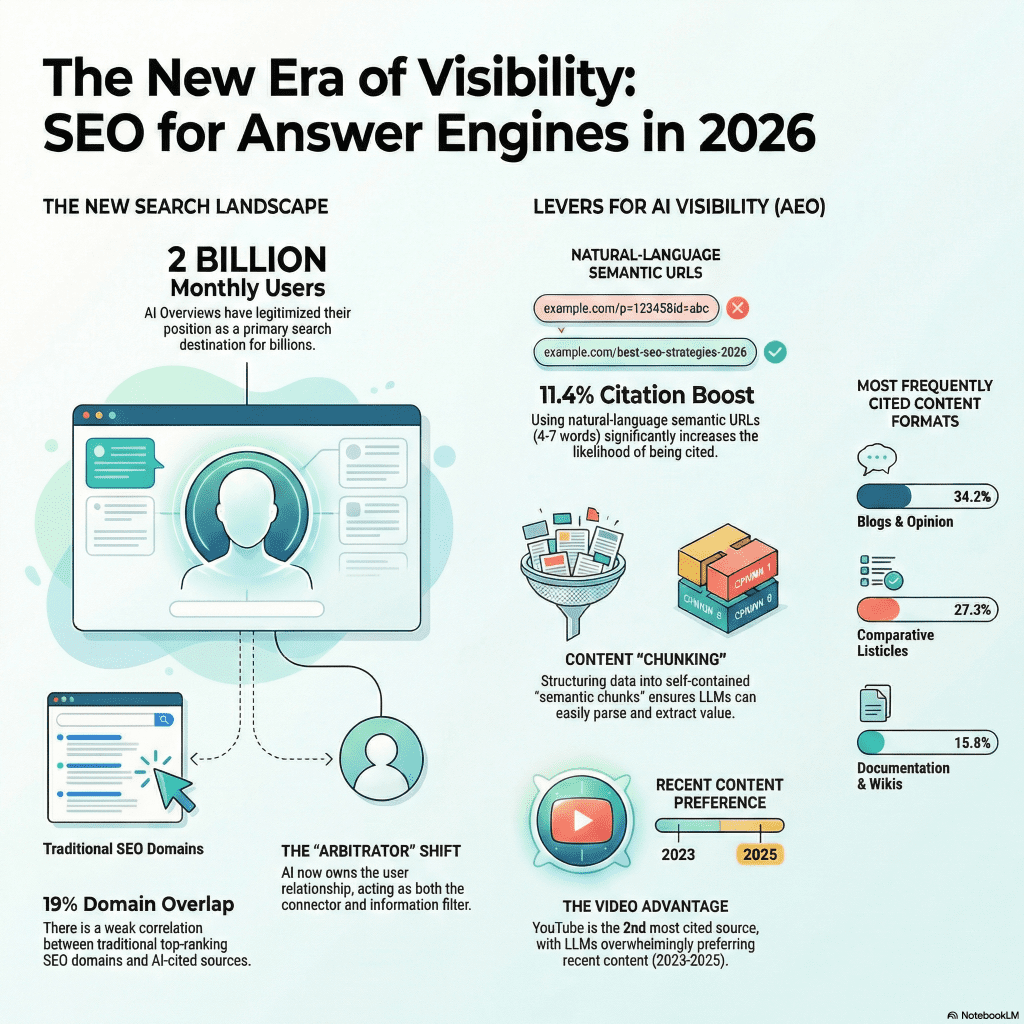
Did you know that “Natural Language URLs” (URLs that sound like a human talking) get 11.4% more citations?
Instead of a URL like mywebsite.com/p=12345, you want something like mywebsite.com/best-running-shoes-for-kids. AI engines compare URLs and pick the one they are most confident will solve the user’s specific problem. If your URL looks like a jumbled mess of numbers and letters, the AI loses confidence in it.
How to optimize your “First Impression”:
- Natural Language Slugs: Use 4 to 7 words in your URL address.
- Semantic Similarity: Make sure your URL title matches what people are actually typing into ChatGPT.
- Meta-Descriptions: Don’t hide the answer! “Spoil” your content in the description so the AI knows you have the facts.
FAQ: How does AI see my website?
- Question: Does ChatGPT read my whole article before citing me?
- Answer: No. It usually reads only a snippet of about 100 characters before deciding whether to click or cite.
- Question: Should I still care about keywords?
- Answer: Yes, but they should be used naturally. AI likes “semantic similarity,” which means using words that relate to the topic in a way humans actually talk.
Content is King (But The King Has a New Job)
In 2026, the type of content you write matters more than ever. The data shows that Blogs and Opinion pieces are now the most-cited category, accounting for 34.2% of all AI citations.
The Shift from Listicles to Deep Expertise
For years, the “Listicle” (like “10 Best Toys”) was the king of the internet. But blogs have now overtaken them. Why? Because AI wants expertise and original thoughts. Anyone can make a list, but only a human expert can offer an opinion that the AI finds valuable.
Freshness is Your Superpower
The internet moves fast, but AI search moves faster. 50% of top-cited content is less than 13 weeks old. If you wrote a great guide in 2023, the AI might ignore it in 2026 because it thinks the information is “stale”. You need to keep your best pages updated constantly to stay in the robot’s good graces.
The Power of “Semantic Chunks”
AI doesn’t read as we do; it reads in “chunks.” You should architect your content so that an LLM (Large Language Model) can digest it easily. This means using clear headings and summarizing your main points in small, self-contained sections.
Content Strategy Checklist:
- Be Opinionated: Don’t just list facts; take a position.
- Update Regularly: Content older than 3 months starts to lose its “freshness” score.
- Use “JSON” Thinking: For products, use structured data so the AI can read your prices and stock levels instantly.
The Social Connection: Why Reddit and YouTube Rule the World
If you want to be cited by AI, you can’t just stay on your own website. You need to be where the people are. In 2026, Reddit is the most cited source in AI search.
The Rise of UGC (User Generated Content)
People trust people. AI engines know this, so they index heavily on UGC. When someone asks ChatGPT for a recommendation, it often looks at what people are saying on Reddit or in YouTube comments.
YouTube: The Transcript is Your Page
YouTube is the 2nd-most-cited source. But here’s the cool part: AI engines like Perplexity and Gemini can actually “read” the transcripts of your videos.
- Recency Bias: AI overwhelmingly prefers recent YouTube videos (from 2023-2025).
- Engagement Matters: While some engines like Perplexity don’t care as much about views, most AI engines prefer videos that have likes and engagement.
How to Use Social Proof:
- Build a Brand Community: Be active on Reddit. If people are talking about you there, the AI will notice.
- Video Strategy: Create helpful YouTube videos. Make sure your spoken words (the transcript) are clear and answer common questions.
Technical Secrets for 2026: Query Fanout and Product Feeds
As we get deeper into 2026, the “under the hood” parts of your website are changing.
Understanding “Query Fanout”
While traditional SEO metrics like authority scores and backlinks are still considered essential, research shows they only explain about 4% to 7% of citations in AI search responses. Doubling these traditional metrics yields only a 25% to 40% increase in visibility, suggesting that AI search is driven primarily by other factors such as content quality, expertise, and freshness. However, traditional SEO remains a prerequisite for AI visibility because if your content is not indexed by Google, it will likely struggle to appear in ChatGPT responses. Currently, ChatGPT’s background retrieval process overlaps with the Google Search Engine Results Page (SERP) by 39%.
Query Fanout (QFO) is a critical mechanism in modern AI search where a single user prompt spawns multiple background searches behind the scenes. Analysis indicates that 89% of prompts result in two to three distinct search queries. Optimising for QFO requires a shift from targeting broad keywords to aligning your content with these specific background queries.
Key strategies for Fanout Query optimisation include:
• Alignment of Metadata: Ensure your page titles, descriptions, and URLs directly mirror the specific phrases an AI might search for during its fanout process.
• Specific URLs: Using a URL like hubspot.com/best-crm-real-estate makes your page a perfect match for a background search for “best CRM real estate”.
• Contextual Signals: Because AI engines often only read a 100-character snippet before deciding to cite a page, your metadata acts as your primary “pitch” to be selected during the fanout phase.
• Controlling the Narrative: QFO is described as the single best tool for brands to take control of how they are represented by AI answer engines.
When you type a prompt into ChatGPT, the AI often runs 2 to 3 background searches to find the best answer. This is called “Query Fanout”.
For example, if you ask, “What’s the best compact suitcase for Europe?” the AI might search for:
- “Best compact suitcases 2025”
- “European airline carry-on size limits”
- “Top-rated suitcases for travel”.
If your content aligns with these specific background searches, you are much more likely to be the “winner” who gets cited.
Moving from Scraping to Product Feeds
In the old days, Google would “scrape” your website to see what you were selling. In 2026, AI engines prefer to talk to your Product Feed (a structured list of your data).
If you run a store, your “Feed” needs to be complete. AI search looks for specific “JSON” fields like:
- inventory_quantity: Is it in stock right now?
- product_review_count: How many people liked it?
- q_and_a: Does the page answer “Is this waterproof?”
Technical Pro-Tips:
- Field Completeness: Fill out every detail in your product data. AI wins are found in the “long tail” of specific searches.
- JavaScript Awareness: ChatGPT can execute JavaScript, but many other engines cannot. Keep your most important information in plain text just to be safe.
How to Measure Success: The Visibility Score
How do you know if you are actually winning? In the past, we looked at “Rankings.” In 2026, we look at Visibility Scores.
Companies like Profound now track how often your brand is mentioned across millions of AI searches. You can see if you have a “Citation Share”—meaning, what percentage of AI answers about your industry actually mention you?.
Monitor and Mimic
If you see a competitor getting cited more than you, look at why.
- Is their content fresher?
- Is their URL more descriptive?
- Do they have more FAQs on their page? (FAQ-heavy pages get 848% more citations!).
Final Thoughts: The Opportunity of a Lifetime
Search is changing, but that’s actually good news. As a former SEO expert once said, AI search is becoming the “sexiest” area of digital marketing. We finally have the chance to move away from trying to “trick” a computer and move toward actually helping people.
The robot librarian is waiting at the desk. By following these rules—focusing on quality, freshness, and clear communication—you can make sure your website is the one that gets picked every single time.
Common Questions (FAQs)
Q: Is SEO dead?
A: No, but it has evolved into AEO (Answer Engine Optimization). You still need to be findable, but the way you “talk” to the search engine is now more human.
Q: Do I need to be a coder to do this?
A: Not necessarily. While “structured feeds” sound technical, most of this is about writing great content and organizing it clearly for the AI to read.
Q: What is the single most important thing to do?
A: Be fresh. In AI search, the newest, most helpful information often wins, even against much bigger websites.